A Life in the American Century
November 11, 1918
The Armistice Letter
William Yandell Elliott to his mother, from the front in France, on the day the war ended.
Elliott was a first lieutenant commanding a battery of the 114th Field Artillery. The transcription below follows the letter page by page, keeping his spelling and punctuation; his underlining is shown as underlining. A question mark in square brackets marks a word that could not be read with confidence. Select any page to enlarge it.
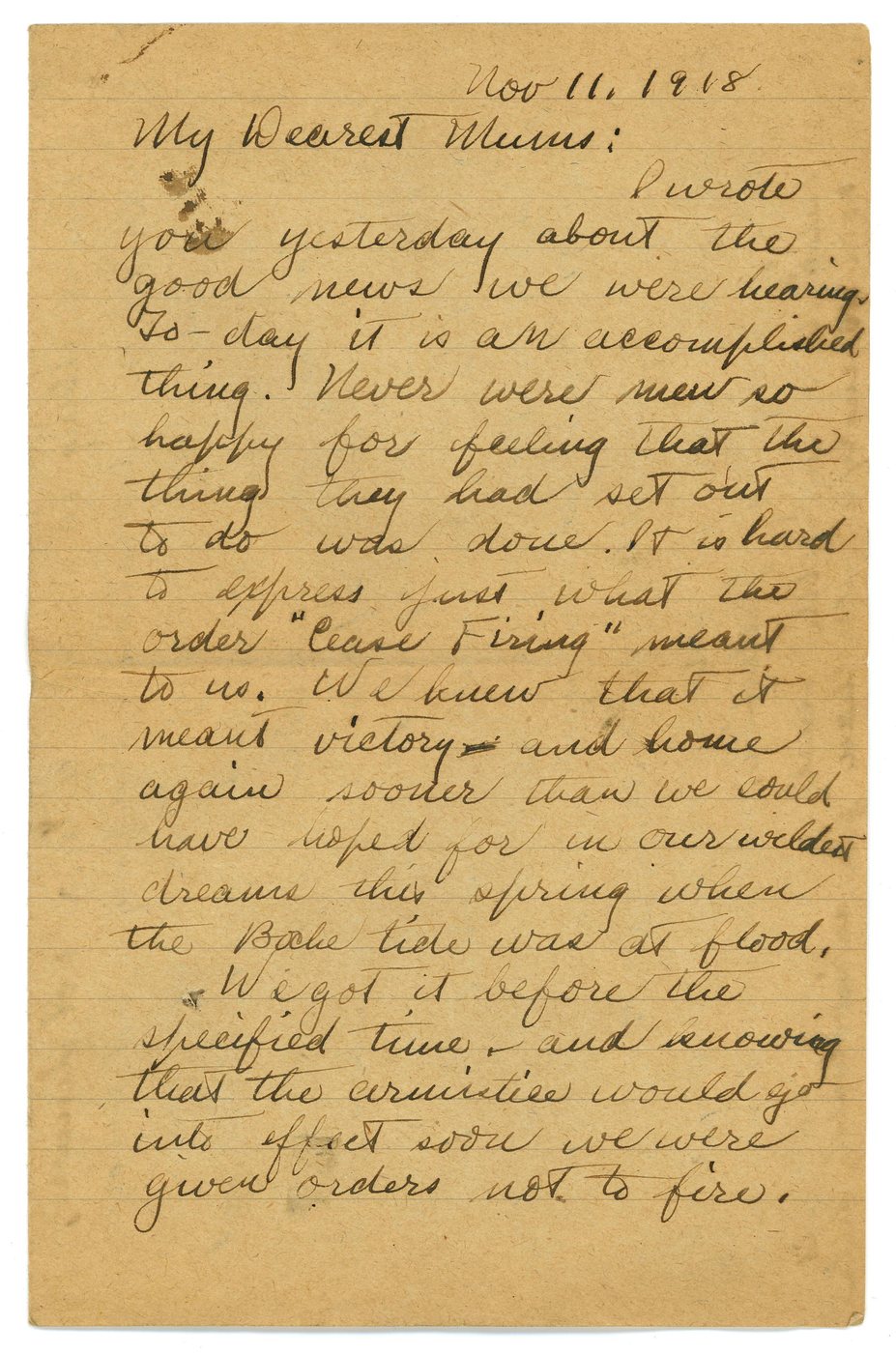
Nov 11, 1918
My Dearest Mums:
I wrote you yesterday about the good news we were hearing. To-day it is an accomplished thing. Never were men so happy for feeling that the thing they had set out to do was done. It is hard to express just what the order “Cease Firing” meant to us. We knew that it meant victory – and home again sooner than we could have hoped for in our wildest dreams this spring when the Boche tide was at flood.
We got it before the specified time – and knowing that the armistice would go into effect soon we were given orders not to fire.
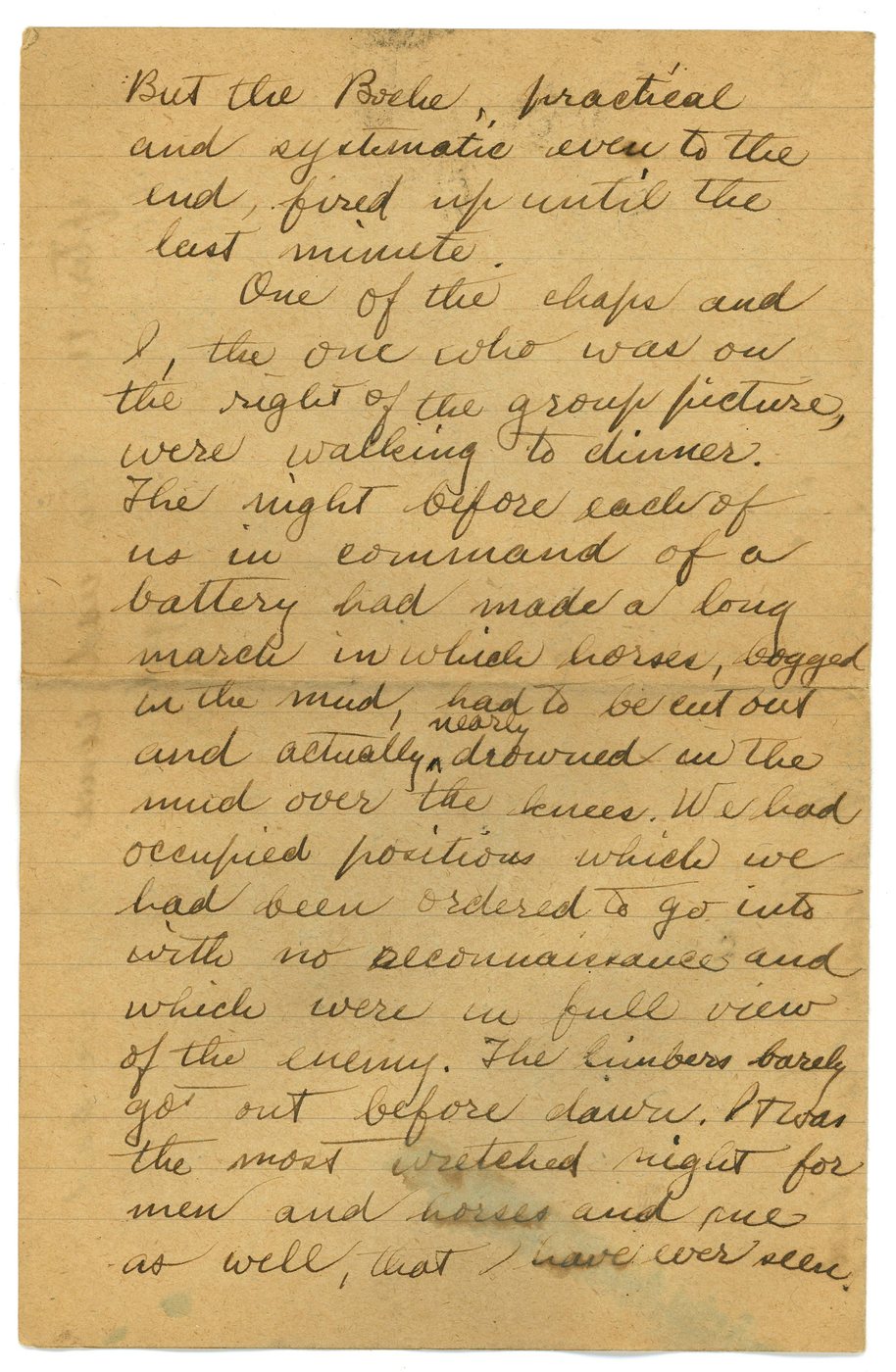
But the Boche, practical and systematic even to the end, fired up until the last minute.
One of the chaps and I, the one who was on the right of the group picture, were walking to dinner. The night before each of us in command of a battery had made a long march in which horses, bogged in the mud, had to be cut out and actually nearly drowned in the mud over the knees. We had occupied positions which we had been ordered to go into with no reconnaissance and which were in full view of the enemy. The limbers barely got out before dawn. It was the most wretched night for men and horses and me as well, that I have ever seen.
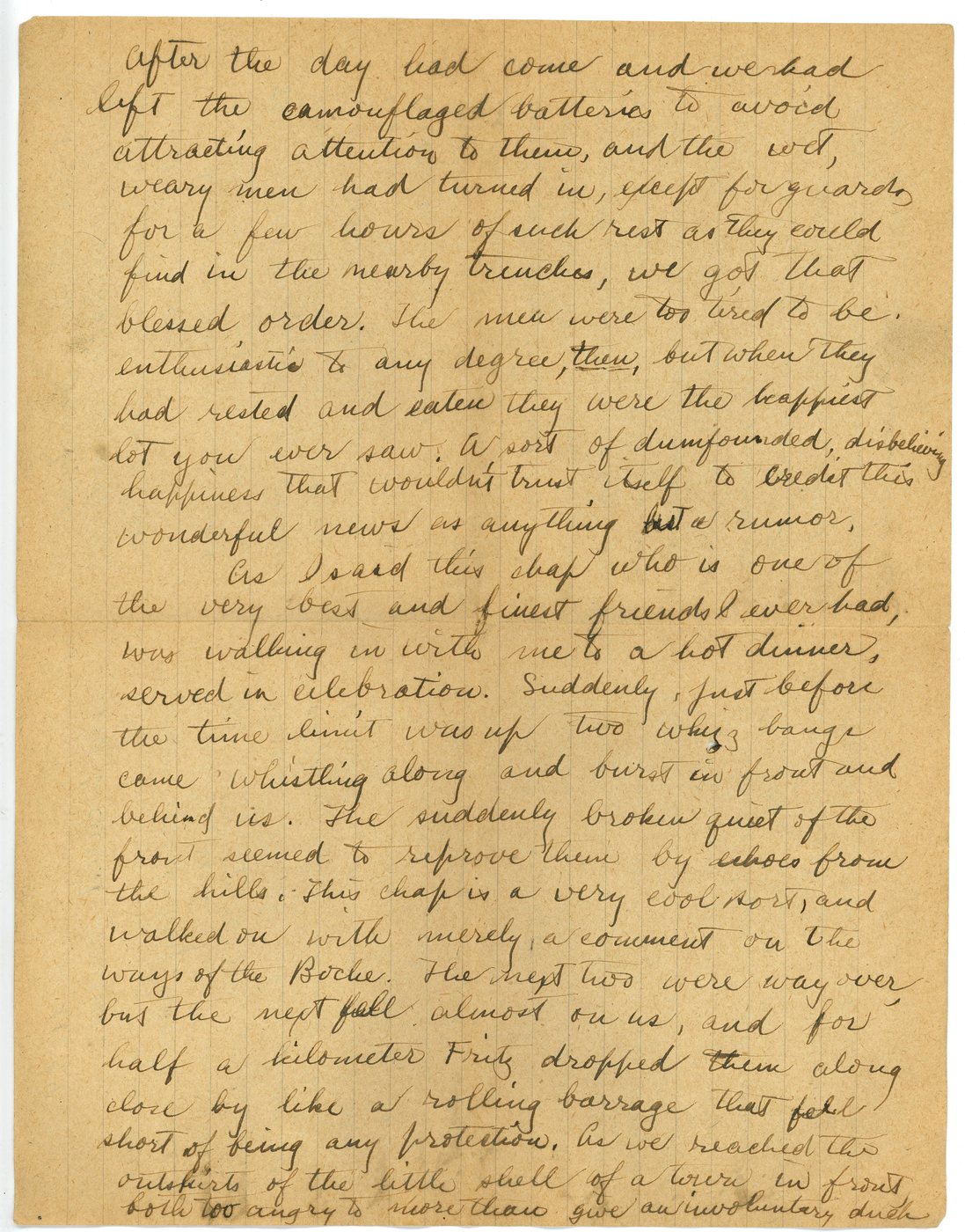
After the day had come and we had left the camouflaged batteries to avoid attracting attention to them, and the wet, weary men had turned in, except for guards, for a few hours of such rest as they could find in the nearby trenches, we got that blessed order. The men were too tired to be enthusiastic to any degree, then, but when they had rested and eaten they were the happiest lot you ever saw. A sort of dumfounded, disbelieving happiness that wouldn’t trust itself to credit this wonderful news as anything but a rumor.
As I said this chap who is one of the very best and finest friends I ever had, was walking in with me to a hot dinner, served in celebration. Suddenly, just before the time limit was up two whizz bangs came whistling along and burst in front and behind us. The suddenly broken quiet of the front seemed to reprove them by echoes from the hills. This chap is a very cool sort, and walked on with merely a comment on the ways of the Boche. The next two were way over but the next fell almost on us, and for half a kilometer Fritz dropped them along close by like a rolling barrage that fell short of being any protection. As we reached the outskirts of the little shell of a town in front, both too angry to more than give an involuntary duck
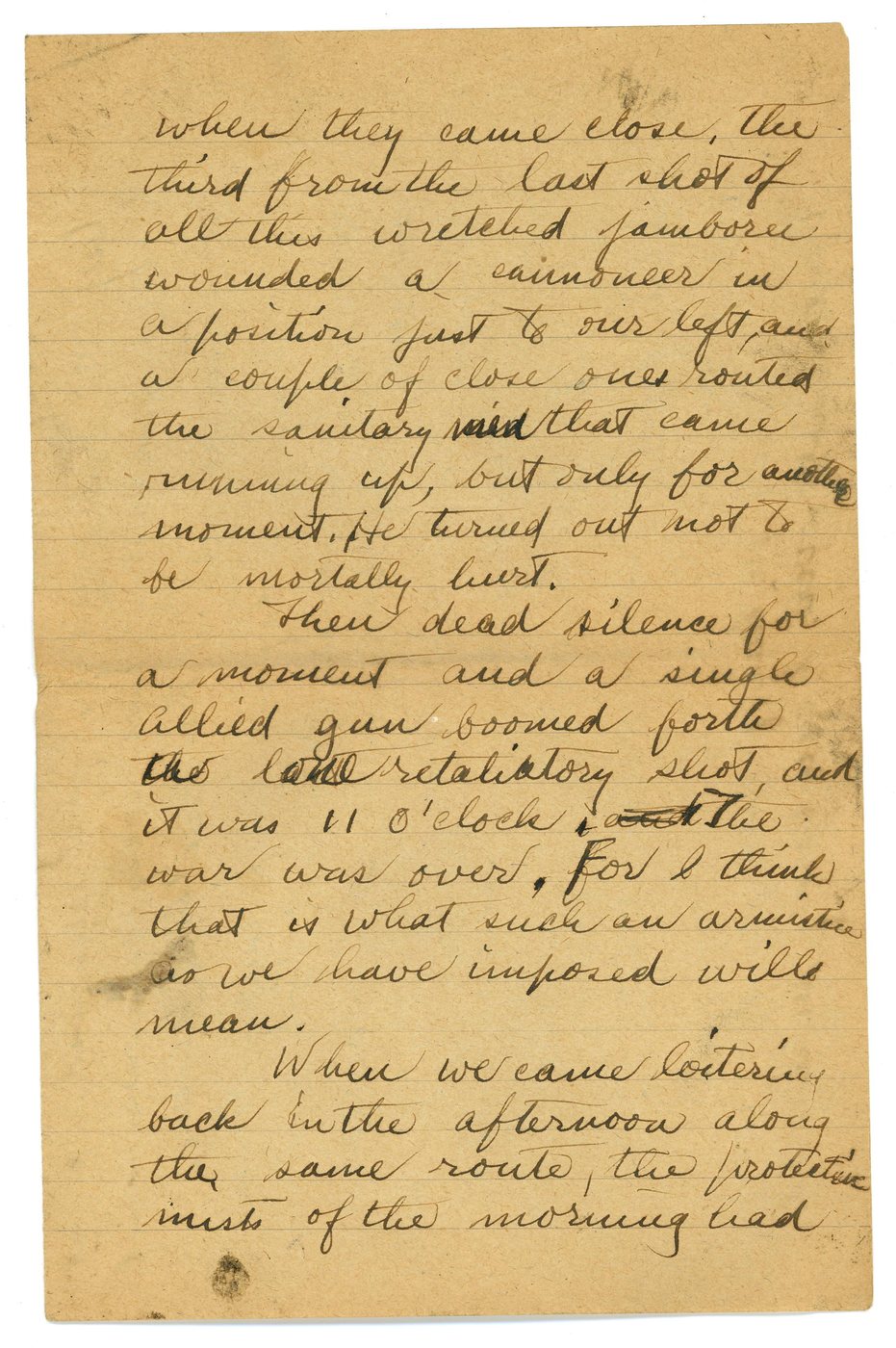
when they came close, the third from the last shot of all this wretched jamboree wounded a cannoneer in a position just to our left, and a couple of close ones routed the sanitary aid [?] that came running up, but only for another moment. He turned out not to be mortally hurt.
Then dead silence for a moment and a single allied gun boomed forth the last retaliatory shot, and it was 11 o’clock; the war was over. For I think that is what such an armistice as we have imposed will mean.
When we came loitering back in the afternoon along the same route, the protective mists of the morning had
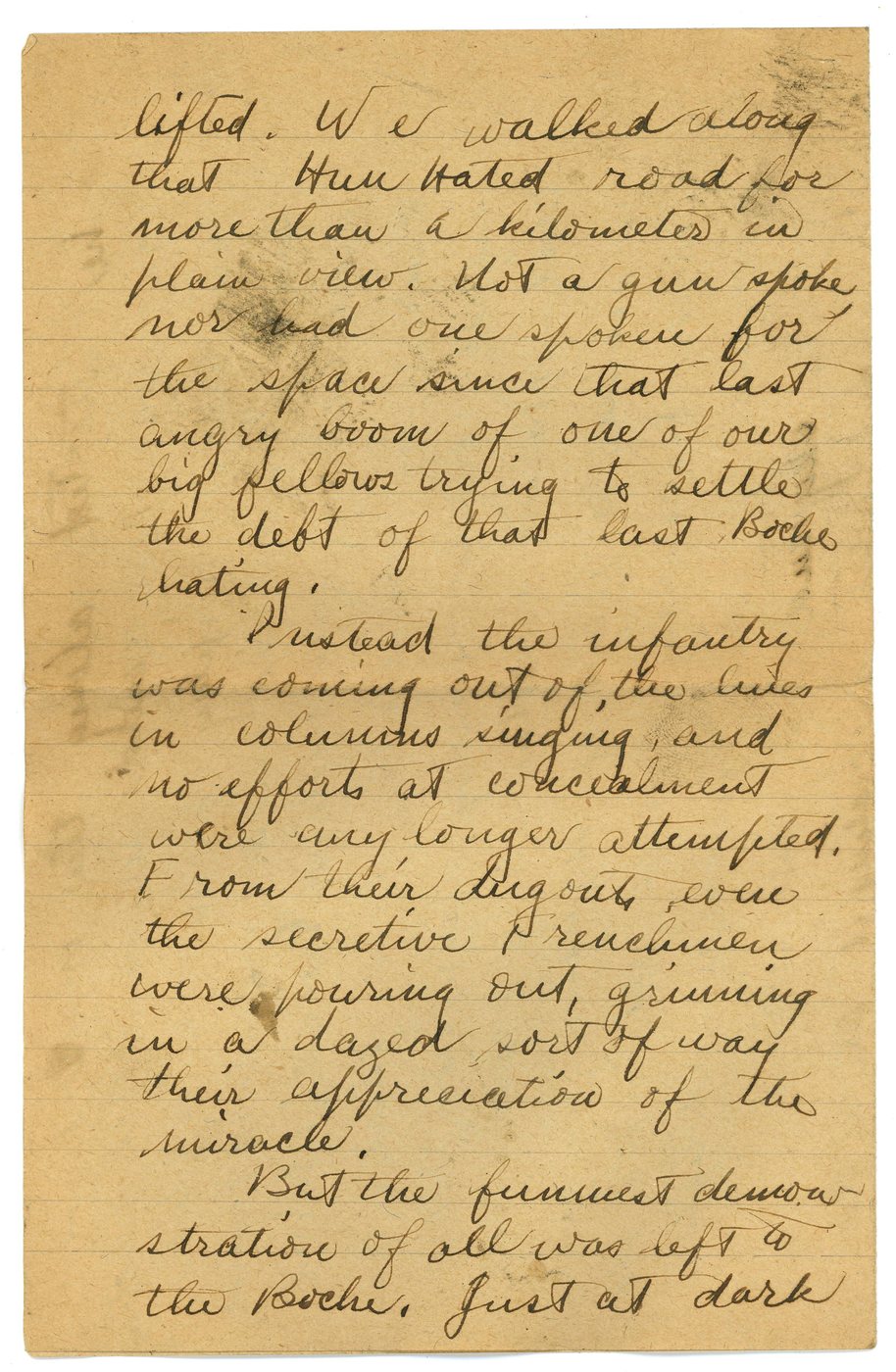
lifted. We walked along that Hun hated road for more than a kilometer in plain view. Not a gun spoke nor had one spoken for the space since that last angry boom of one of our big fellows trying to settle the debt of that last Boche hating [?].
Instead the infantry was coming out of the lines in columns singing, and no efforts at concealment were any longer attempted. From their dugouts even the secretive Frenchmen were pouring out, grinning in a dazed sort of way their appreciation of the miracle.
But the funniest demonstration of all was left to the Boche. Just at dark
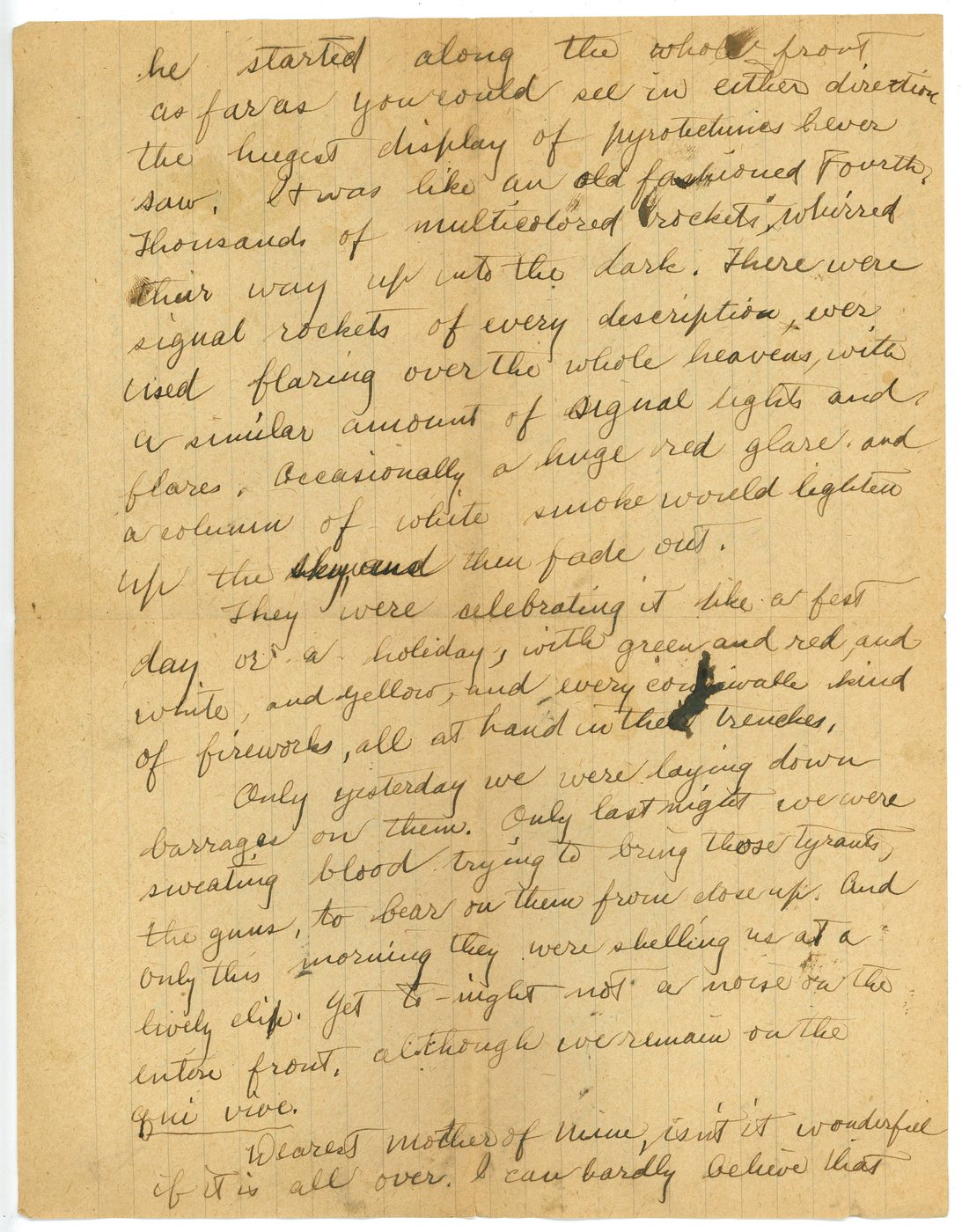
he started along the whole front as far as you could see in either direction the hugest display of pyrotechnics I ever saw. It was like an old fashioned Fourth. Thousands of multicolored rockets whirred their way up into the dark. There were signal rockets of every description, ever used flaring over the whole heavens, with a similar amount of signal lights and flares. Occasionally a huge red glare and a column of white smoke would lighten up the sky and then fade out.
They were celebrating it like a fest day or a holiday, with green and red, and white, and yellow, and every conceivable kind of fireworks, all at hand in the trenches.
Only yesterday we were laying down barrages on them. Only last night we were sweating blood trying to bring those tyrants, the guns, to bear on them from close up. And only this morning they were shelling us at a lively clip. Yet to-night not a noise on the entire front, although we remain on the qui vive.
Dearest Mother of mine, isn’t it wonderful if it is all over. I can hardly believe that
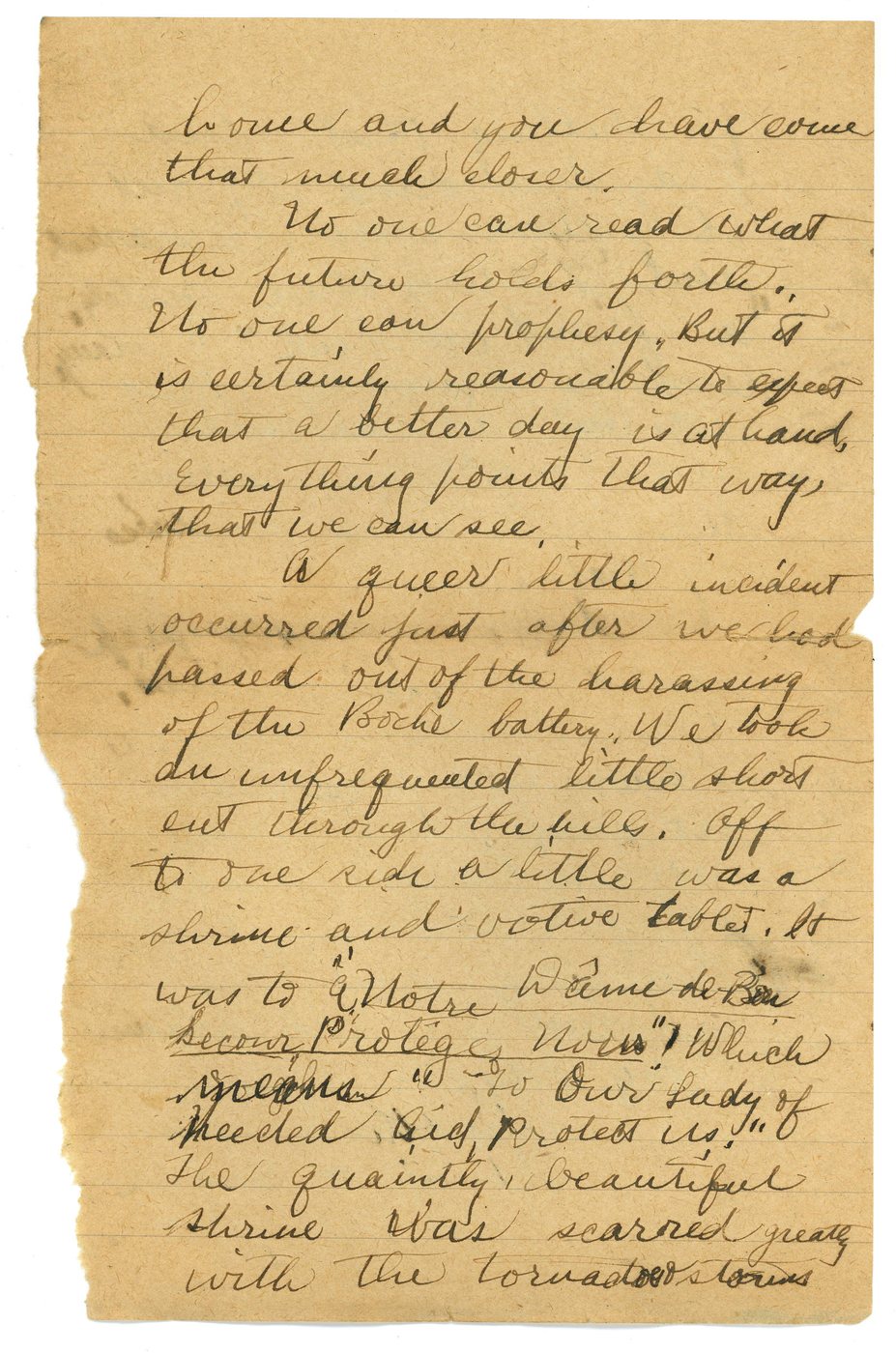
home and you have come that much closer.
No one can read what the future holds forth. No one can prophesy. But it is certainly reasonable to expect that a better day is at hand. Everything points that way, that we can see.
A queer little incident occurred just after we had passed out of the harassing of the Boche battery. We took an unfrequented little short cut through the hills. Off to one side a little was a shrine and votive tablet. It was to “A Notre Dame de Bon Secour, Protégez Nous”! Which means “To Our Lady of Needed Aid, Protect us.” The quaintly beautiful shrine was scarred greatly with the tornado storms
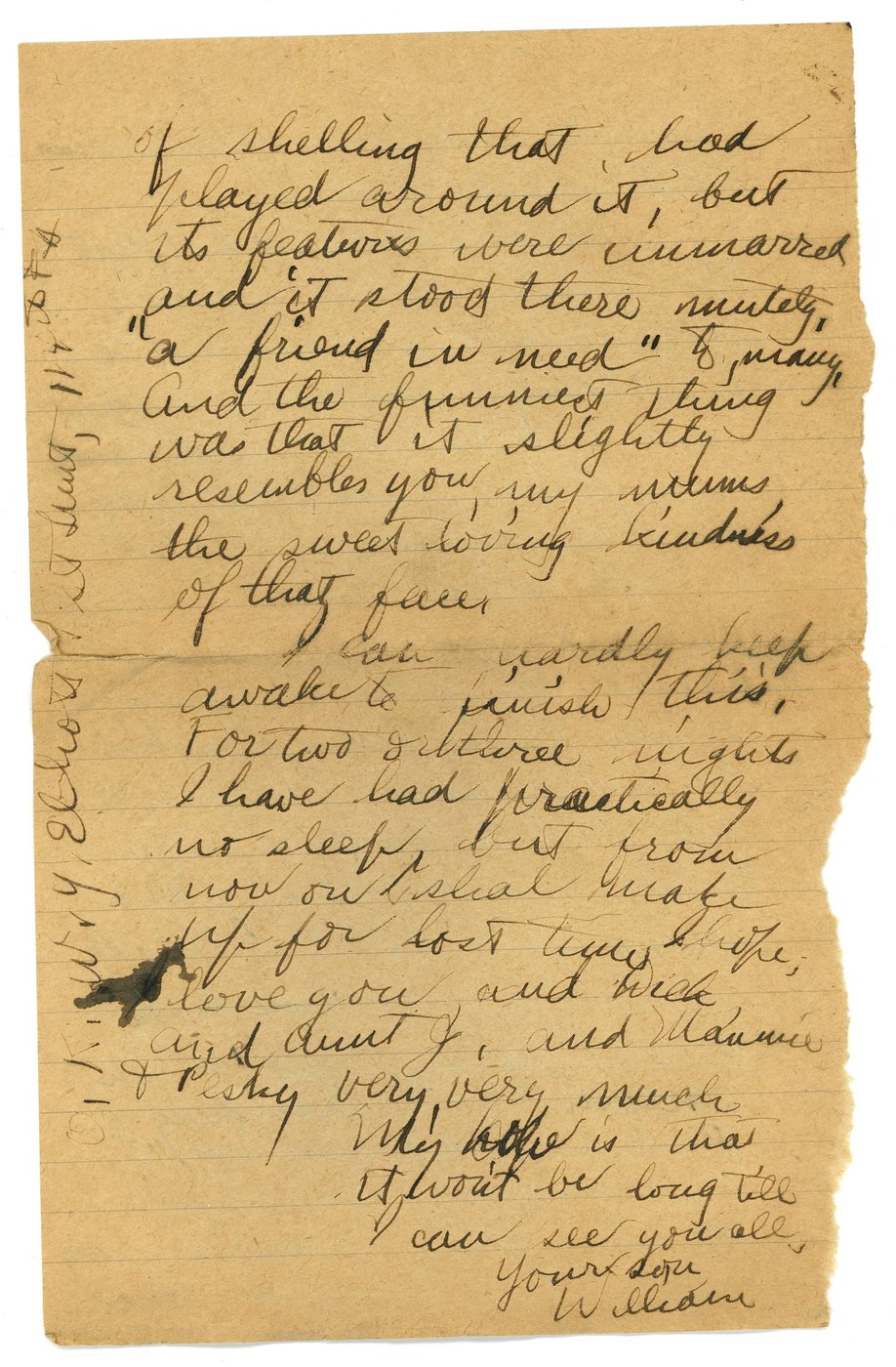
of shelling that had played around it, but its features were unmarred and it stood there mutely, “a friend in need” to many. And the funniest thing was that it slightly resembles you my mums the sweet loving kindness of that face.
I can hardly keep awake to finish this. For two or three nights I have had practically no sleep, but from now on I shall make up for lost time I hope. Love you and Dick and Aunt J. and Mammie [?] & Pesky [?] very very much.
My hope is that it won’t be long till I can see you all.
Your son
William
Written up the left margin: “O.K. W. Y. Elliott, 1st Lieut, 114 F.A.”
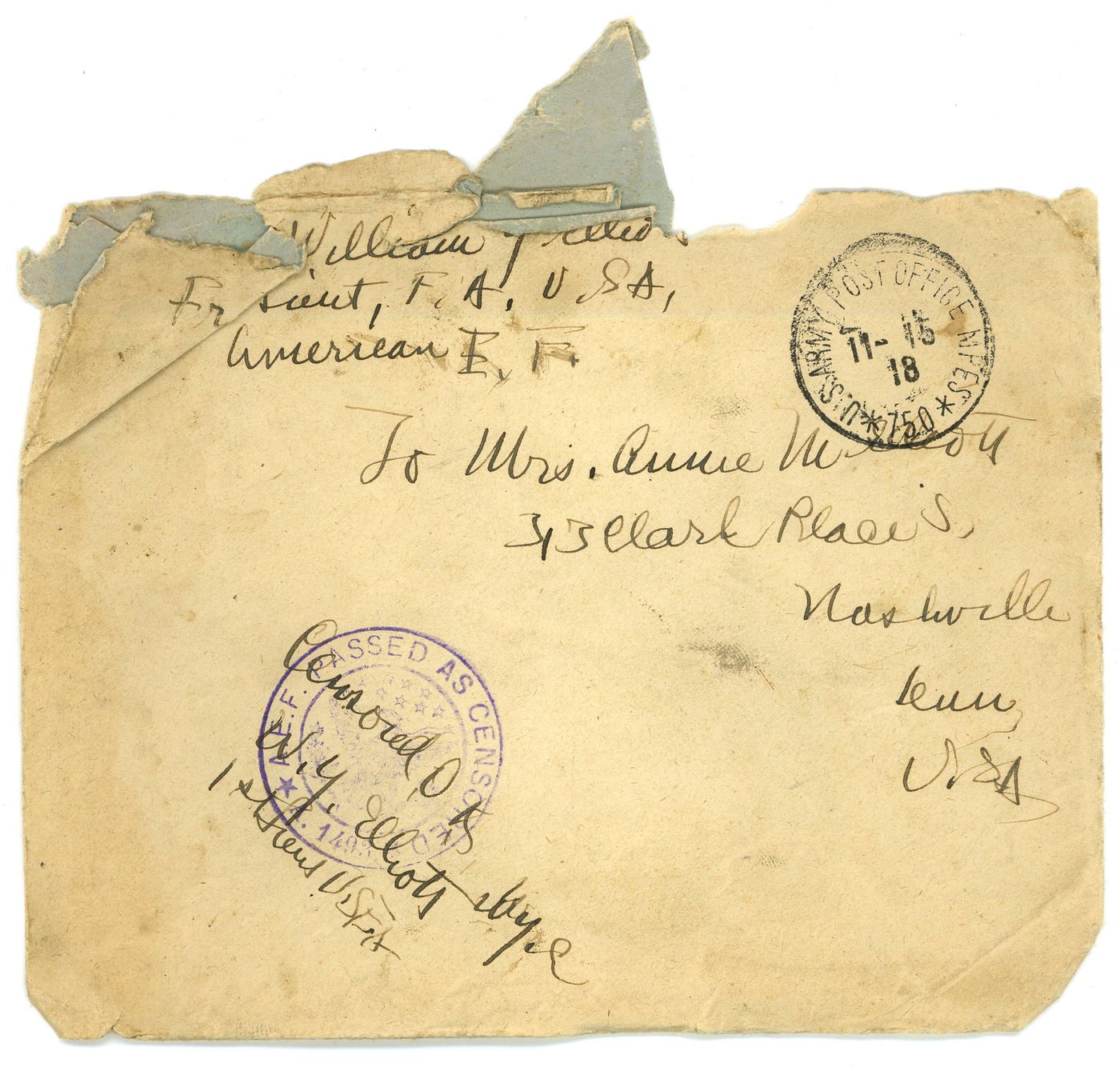
Addressed to Mrs. Annie M. Elliott in Nashville, Tennessee, and postmarked by the American Expeditionary Forces’ postal service. Parts of the address are too worn to read with confidence.